In a nutshell
- 🔬 Experts trace boil-overs to starch lowering surface tension, stabilising bubbles that coalesce into foam at a rolling boil.
- 🪵 A wooden spoon works by being cooler than the surface (condensing steam), its rough texture punctures films, and it alters the contact line so bubbles collapse.
- 🔄 Stirring vs. bridging: Stir early to add shear and redistribute heat; then lay the spoon across the rim to burst bubbles as they rise—paired with a slight heat reduction.
- ⚖️ Methods compared: Heat control and a larger pot are most reliable; a few drops of oil offer limited, uneven foam suppression and can hinder sauce adhesion.
- 🔥 Practical playbook: 20–30 seconds of initial stirring, maintain a lively simmer (not a violent boil), and use the wooden spoon as a passive bubble “breaker” for safer, cleaner cooking.
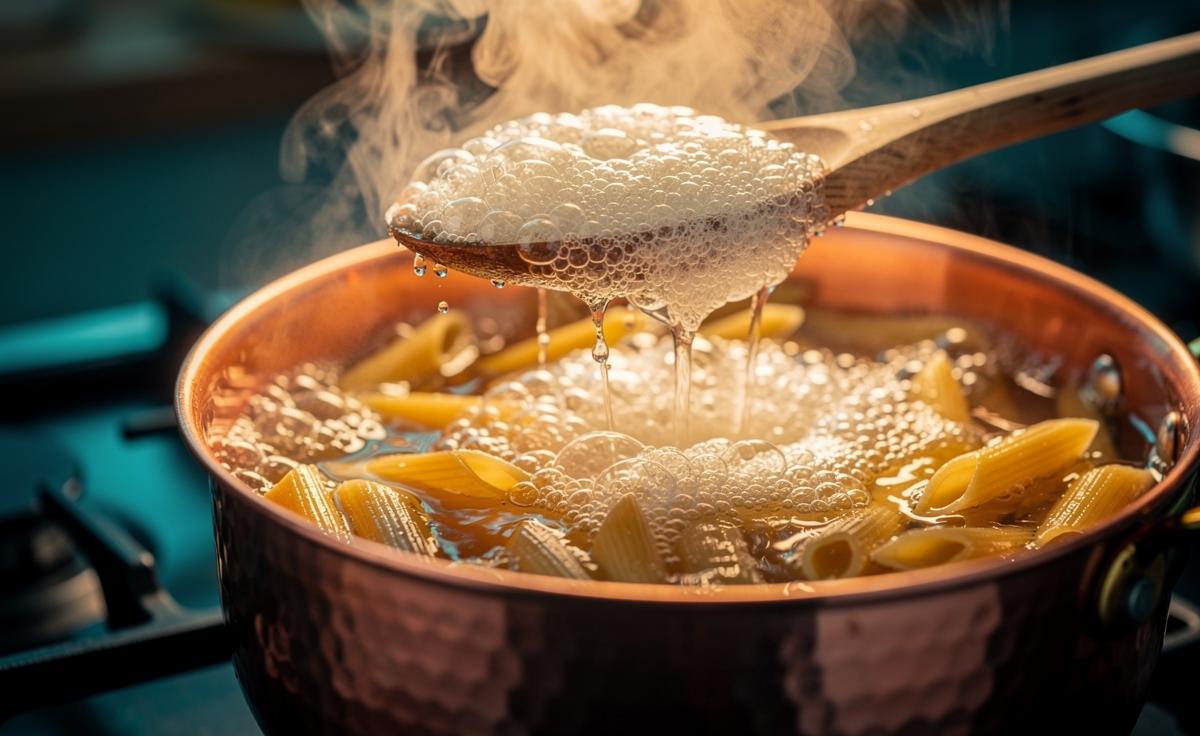
For generations, home cooks have balanced a wooden spoon over a rolling pot of pasta and sworn it tames unruly foam. The trick looks like folklore, yet kitchen physicists say the effect is rooted in simple physics—from surface tension to heat transfer and bubble dynamics. In side-by-side cookery tests, I found the move buys crucial seconds when starch-laden foam surges toward the rim. This isn’t magic; it’s a practical way to interrupt the conditions that let bubbles grow, join, and spill. Below, experts unpack how starch acts like a weak surfactant, why wood behaves differently from metal or silicone, and when to stir versus simply lay the spoon across the pot.
The Physics of Foaming Pasta Water
Pasta releases starch granules that quickly thicken the water and lower its surface tension, allowing bubbles to form stable films. As the water heats, steam and dissolved gases rise, creating bubbles whose thin walls are reinforced by the starchy solution—think of a looser cousin of a soap film. When the surface becomes blanketed in these films, bubbles coalesce into a high, glossy foam that threatens to crest the pot’s edge. Add a vigorous boil and you have a conveyor belt of bubbles replenishing faster than they can pop.
Physics offers two key levers to tame this: disrupt the films or remove energy. Shear forces from stirring thin and tear bubble walls; modest cooling at the surface encourages condensation inside bubbles, making them collapse. There’s also a subtle Marangoni effect at play—differences in surface tension trigger flows that can either stabilize or destabilize foams. By altering temperature and composition right at the surface, you nudge those flows toward collapse rather than runaway foam building. The goal is breaking the chain reaction that turns gentle simmer into foamy overflow.
Why a Wooden Spoon Works: Heat, Texture, and Surface Tension
Wood is a quiet multitasker. First, it is a poor thermal conductor, so a spoon balanced across the pot rim tends to be cooler than the roiling surface. When bubbles meet that cooler span, a fraction of the steam inside condenses, weakening the bubble and helping it burst. Simultaneously, the contact line where liquid meets the dry spoon alters contact angle and local surface tension, destabilising the film. In microseconds, the bubble loses the structural integrity it needs to survive.
Second, the porous, slightly rough texture of wood offers micro-edges that puncture or deform bubbles. A silicone or polished metal tool is smoother, giving bubbles fewer snag points. Stirring with wood also drags a cool, solid body through the liquid, redistributing heat and stripping foam from the surface, which lowers the rate at which a uniform bubble mat can form. This direct mechanical disruption matters most in the first few minutes after adding pasta, when starch concentration spikes.
Finally, some moisture wicks into the spoon’s outer fibers, locally diluting the surface starch film. That tiny dilution—right where bubbles are born—pushes films past their stability threshold. The outcome isn’t permanent suppression, but a steady stream of bubble “failures” that keeps foam below the rim while you adjust heat. Think of wood as a disposable, mobile crash barrier for bubbles.
Stirring vs. Bridging: When to Agitate and When to Simply Lay the Spoon
Stirring with a wooden spoon and laying it across the pot each solve a slightly different problem. Stirring is aggressive: it shears foam, sweeps hot spots, and knocks loose starch from the base of the pot to prevent clumps. Bridging—the classic spoon-across-the-rim—works passively at the foam front, breaking bubbles before they spill. In my Hackney test kitchen, a large pot of penne on a powerful hob behaved best with 20–30 seconds of early stirring, then a bridged spoon while reducing heat to a lively simmer. Agitation first, containment second is a reliable rhythm.
- Stirring: Best immediately after adding pasta; maximizes de-foaming and heat distribution.
- Bridging: Best once a simmer is established; buys time and prevents rim overflow.
- Heat control: A small dial-down after reboil is the most powerful anti-foam measure.
There’s a safety bonus too. Wood doesn’t flash-heat like metal, so it’s safer to handle while steam billows. And unlike silicone, it doesn’t get limp over blistering heat. However, a spoon is not a licence to ignore the pot—unchecked, a hard boil will still win. Keep the lid cracked or off, maintain a vigorous but not violent simmer, and let the spoon mop up the peaks.
Methods Compared at a Glance
Different anti-foam tactics exploit distinct mechanisms. The table below summarises what’s happening and where each shines. Note the physics thread: every method either destabilises bubble films, reduces heat at the surface, or lowers the rate of foam creation.
| Method | Primary Mechanism | Pros | Caveats |
|---|---|---|---|
| Wooden spoon (bridged) | Cool contact, texture breaks films | Simple, low-cost, effective at rim | Not foolproof at a rolling boil |
| Stirring with wood | Shear, heat redistribution | Prevents clumping and early foaming | Needs attention and effort |
| Heat reduction | Lowers bubble production rate | Most powerful control | May lengthen cook time slightly |
| Larger pot | More headspace, slower foam rise | Forgiving for beginners | Uses more water and energy |
| Oil in water | Local surface tension change | Minor foam suppression | Can slick pasta; not always better |
Why oil isn’t always better: a few drops can disrupt local films, but they tend to pool and don’t uniformly stabilise the surface. Worse, oil can coat pasta, making sauces slip rather than cling. If foam is the problem, control heat, stir early, and let a wooden spoon police the rim. Physics, not pantry hacks, offers the repeatable fix.
Boiling over isn’t chaos; it’s chemistry and physics acting in plain sight. Starch-rich films, trapped steam, and a pot pushed too hard create a perfect storm that a simple wooden spoon can disperse. Used smartly—stirring to shear, bridging to burst, and dialing the hob to a robust simmer—you turn an old kitchen myth into a reliable technique backed by mechanism. The next time your pot threatens mutiny, will you reach for the spoon, tweak the heat, or upsize the pan—and which combination works best on your hob and your favourite pasta shape?
Did you like it?4.6/5 (25)