In a nutshell
- 🔑 Adopt a labelled hook rail by the door to give every set a single, consistent “home,” streamlining the door → hook → bag flow and eliminating daily scavenger hunts.
- 🎨 Use colour-coded tags and short labels; pair colours with textures/shapes for accessibility, hide sensitive details inside folding tags, and run a one-minute monthly refresh for spares and fobs.
- 📱 Choose habits over gadgets for everyday calm—trackers help when keys are truly lost, but a rail prevents loss; best balance: a hybrid setup with one tracked set for out-of-home use.
- ⏱️ Build a micro-routine (arrive: hang keys; depart: grab from rail), add a bag carabiner, set shared house rules, and keep a sealed spare with a neighbour for resilience.
- 💷 Enjoy immediate stress relief at low cost: £6–£15 and 3–5 minutes to install; real-world tally showed ~six minutes saved each morning, outperforming bowls and magnetic strips.
Five frantic minutes hunting for misplaced keys is not a life crisis, but it is a daily tax on your attention. As a UK reporter dashing between interviews and school runs, I’ve learned that tiny systems beat sprawling solutions. Here’s the simplest, immediately effective method I’ve tested: a labelled hook rail mounted by the door, paired with colour-coded tags that make the right key obvious at a glance. Reduce the choices, reduce the stress. It takes under five minutes to set up, costs less than a takeaway, and—crucially—creates one reliable “home” for every key. You’ll reclaim time, lower morning tension, and stop the low-level dread that follows you all day.
The One-Minute Fix: A Labelled Hook Rail by the Door
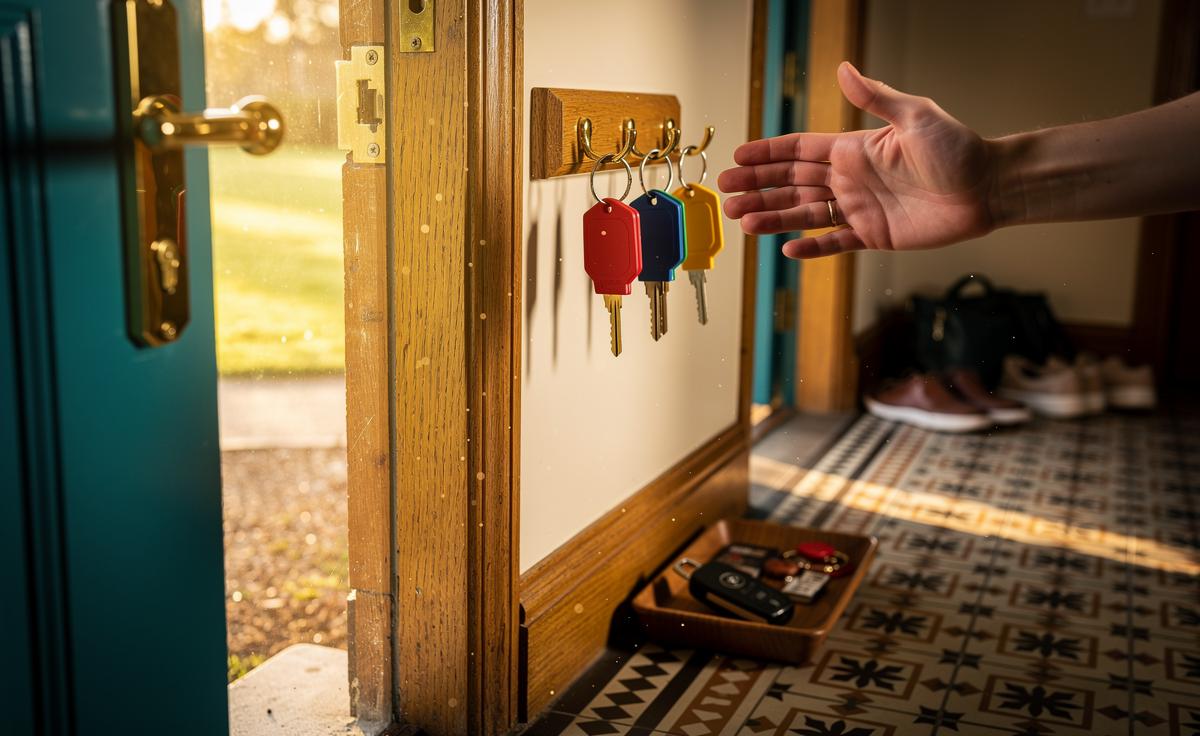
The heart of this system is a small hook rail (three to six hooks) fixed just inside your front door at eye level. Allocate each hook to a specific purpose—Front Door, Car, Office, Spare—and add short labels. The moment you step in, keys go straight onto their assigned hook. The moment you leave, you pick them up from the same place. The destination never changes, so your brain stops running a daily scavenger hunt. If you rent, choose adhesive-backed rails that remove cleanly; if you own, a pair of screws will do.
Placement matters more than the product. Put the rail on the wall you naturally face while locking or unlocking. Keep it within the “drop-zone triangle”: door → hook rail → bag/shoes. That three-step flow halves the chance of a detour (and a later panic). Add a small tray beneath for post, fobs, and the odd Allen key that always appears when you least expect it.
As a field journalist, I used to leave keys in jacket pockets, camera bags, and kitchen bowls. After installing a rail, my notebook tallies showed an average of six minutes saved on weekday mornings—thirty minutes a week I no longer donated to avoidable stress. It’s not about tidiness; it’s about cognitive relief. Your future self does not want a prettier bowl; it wants a single, consistent action that takes one second to execute.
| Method | Typical Cost (UK) | Setup Time | Stress-Reduction Score (1–5) | Best For |
|---|---|---|---|---|
| Labelled Hook Rail | £6–£15 | 3–5 mins | 5 | Households, renters, guests |
| Key Bowl | £0–£20 | 0 mins | 2 | Solo living, low key volume |
| Magnetic Strip | £8–£18 | 5–10 mins | 3 | Metal keys, minimal look |
| Smart Tracker (e.g., tag) | £25–£35 | 10–15 mins | 3–4 | Backups, travel kits |
Colour-Coding and Labelling Your Future Self Will Thank You
Labels solve the “which hook?” question; colour-coding solves the “which key?” question. Slip coloured key rings or silicone caps onto each set and match them to the hook labels. Think in categories, not colours: Red for urgent or security-heavy (front door), Blue for commute (car, bike lock), Green for household (shed, meter box), Yellow for guests or spares. If it isn’t obvious at a glance, it isn’t organised. Add a printed or label-maker tag with two words max—Front Door, Office Gate, Bike D-Lock.
For homes with multiple users, clarity beats aesthetics. Duplicate the code for each person’s set so “Red = Front Door” is universal. If anyone is colour-blind, pair colours with distinct textures or shapes: ribbed ring for front door, square tag for car, round tag for garden. Keep labels short, and put sensitive details (flat number, full name) on the inside of a folding tag rather than on show. It’s tidy, but more importantly, it’s safer.
Set a monthly one-minute refresh: remove dead keys, wipe down tags, and test any fobs. Keep a small pack of coloured rings and blank labels in the drawer for new keys. For guest stays or pet sitters, create a temporary “Yellow” set with a simple instruction card: alarm code, bin days, broadband reset. Make the right action the easiest action—the system should guide a half-asleep you at 6 a.m. and a confused cousin at Christmas with equal grace.
- Red = Front door and alarm
- Blue = Car, bike, work locker
- Green = Garden, shed, utilities
- Yellow = Guests, trades, temporary
Why Smart Trackers Aren’t Always Better than Simple Habits
Smart tags are brilliant when keys are genuinely lost out in the world. But for everyday stress—the 8:12 a.m. can’t-leave-now wobble—simple habits outperform gadgets. Trackers add cost, pairing, batteries, and occasional false alarms. A hook rail with labels and colours removes the hide-and-seek loop altogether. Prevention beats detection. That said, hybrid setups work well: keep a tracker on the one set you’re most likely to carry off-site (car or office keys), while the household rail remains the daily anchor.
There are also context issues. Some UK flats have thick walls or patchy Bluetooth in communal hallways, which blunts real-time locating. Late-night beeps can wake children. And renters may prefer adhesive rails to avoid drilling or broadcasting location data to third-party networks. A low-tech base with a high-tech parachute is usually the calmest compromise.
- Trackers: Pros
- Find keys beyond the house (parks, gym, train)
- Shareable locating for partners or housemates
- Helpful during travel and hotel stays
- Trackers: Cons
- Battery and app maintenance
- Signal limits indoors; occasional false pings
- Added bulk; privacy considerations
My own mini-tally over three months: zero “Where are my keys?” moments on rail days; two tracker-assisted finds when I left a set in a filming van. The message is clear: use habit for the everyday, tech for the outliers. The calmest system is the one you don’t have to think about.
A Micro-Routine That Cuts Friction Morning and Night
Systems stick when they’re tied to cues you already obey. Anchor your keys to a micro-routine you perform without thinking: entering and leaving. On entry: keys to the rail, then shoes off, then coat. On exit: shoes on, keys from rail, door. Consistency beats complexity. If you carry a bag, clip a small carabiner to an inner D-ring so the keys always hang in the same place—then the whole set returns to the rail when you get home.
Households need shared rules. Post a tiny sign above the rail: “Hooks: Door, Car, Office, Spare.” Make it obvious where visitors should leave keys; the system should survive guests, teenagers, and a 5 a.m. taxi. For children, use pictograms (door icon, car icon) and a tactile tag. For flat-shares, assign one hook per person and one communal spare; a quick glance tells you who’s out without a flurry of messages.
Build in “what if?” resilience: keep a sealed spare with a trusted neighbour, store duplicates for infrequent locks in a labelled envelope at home, and clip travel keys (luggage, padlocks) to a bright temporary tag that lives on the rail only during trips. Test your escape route: shoes, wallet, keys, bag. Time it once. Then stop timing it forever—because the routine will carry you. Friction makes stress; repetition erases friction.
- Arrive: hang keys → shoes off → coat away
- Depart: shoes on → keys from rail → lock, leave
- Weekly: purge stray keys → wipe tags → test fobs
In journalism we talk about “removing the noise” to let the story breathe. A labelled hook rail and a splash of colour do the same for your mornings, removing a thrum of anxiety you’d stopped noticing. Start with the rail; add labels and colours; consider one smart tag as a safety net. Within days you’ll feel the difference. Small, visible systems create large, invisible peace. How will you tailor this simple key routine—placement, colours, labels—to fit your front door and the rhythms of your home this week?
Did you like it?4.4/5 (28)