In a nutshell
- 💧 The efficiency edge comes from closed-loop recirculation, precise heat control, and soil sensors that tailor cycles—letting enzymes work at lower temps for cleaner plates with less water and energy.
- 📊 By the numbers: a modern eco cycle uses 9–12L, versus careful handwashing at 25–40L or a running tap at 60–100L—cutting hot-water kWh and CO₂; a typical UK family can save ~7,300L/year.
- ⚖️ Pros vs cons: Dishwashers deliver consistent hygiene, lower water per place setting, and passive time savings; caveats include very small households, older units (18–22L), pre-rinsing habits, and embodied carbon trade-offs.
- 🛠️ Maximise gains: Scrape, don’t rinse; choose the eco program; run full loads (or half-load/zone wash), optimise loading to avoid blocking spray arms, clean filters, maintain salt/rinse aid, and use enzyme-rich detergents.
- 🇬🇧 UK context: With rising water stress and volatile energy prices, dishwashers offer reliable savings on bills, emissions, and time—especially when paired with smart habits and efficient models.
Across British kitchens, the quiet revolution humming beneath the counter is the modern dishwasher. Far from being a luxury, today’s machines are engineered to use less water and less energy than a typical handwash, while delivering consistent hygiene and saving time. The secret lies in closed-loop water recirculation, precise heat control, and smarter cycles that respond to how dirty your crockery really is. In a country where water stress is creeping beyond the South East and energy prices remain volatile, choosing the right cleaning method is a small act with outsized impact. Below, we look under the stainless-steel skin—numbers, trade-offs, and tips—to explain why dishwashers aren’t just convenient; they are, in most homes, the more sustainable choice.
The Science of Using Less: Closed-Loop Sprays and Smarter Heat
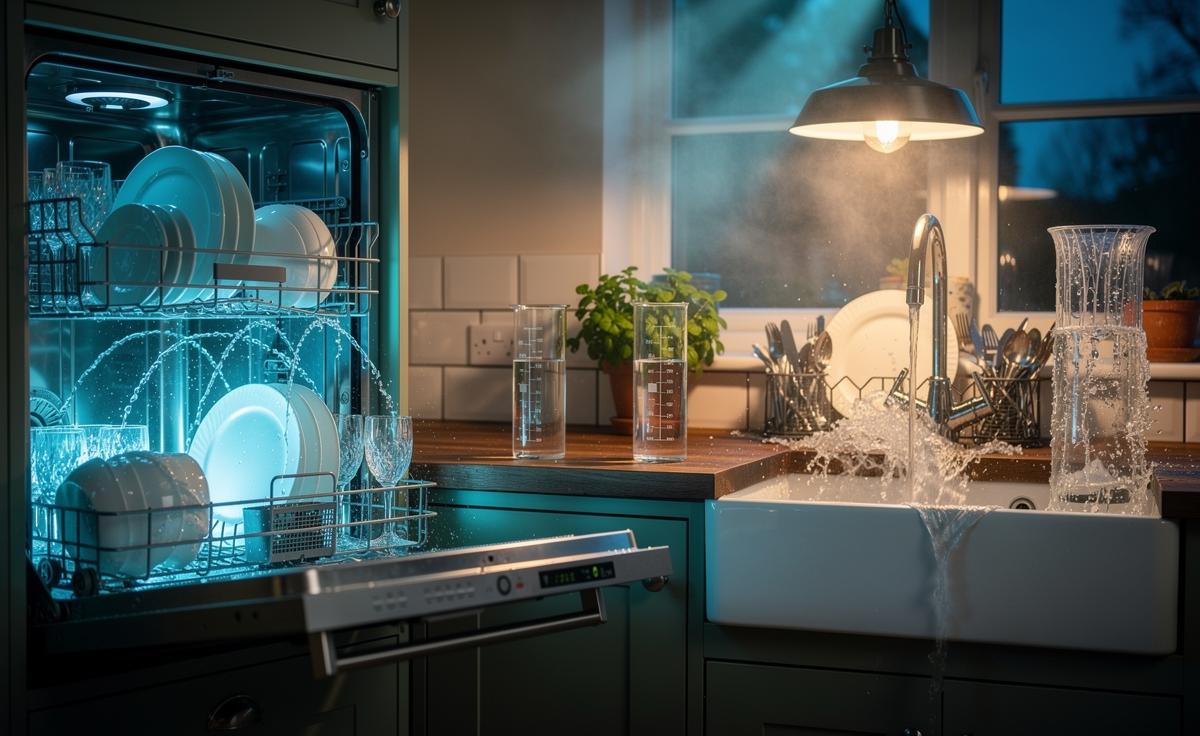
At the heart of a dishwasher’s efficiency is recirculation. Instead of sending a continuous stream down the drain, the appliance pressurises a small volume—often 9–12 litres on an eco cycle—and fires it repeatedly through spray arms to shear off food residue. Because the same water does multiple laps, detergents and enzymes reach optimal concentrations, meaning you need less of everything—water, heat, and chemicals—to achieve a hygienic finish. This is where handwashing, which commonly relies on a running tap or frequent sink changes, loses the efficiency race.
Modern machines add brains to brawn. Soil sensors (turbidity meters) tune cycle time and temperature to the real load, while eco programs exploit longer, gentler heating that cuts electricity use by allowing enzymes to work at 45–50°C. Many units use heat exchangers to pre-warm incoming water or recover heat during condensation drying, shaving further kilowatt-hours. The engineering goal is simple: maximise heat transfer to grime, not to the room or down the drain. In practice, that means a well-loaded dishwasher can out-clean a rushed handwash with a fraction of the resources. Load fully, skip pre-rinsing, and let the machine’s sensors do the thinking.
Water Savings in Numbers: How Dishwashers Beat the Tap
The biggest misconception is that bowls full of suds always beat machines. Real usage tells a different story. An efficient dishwasher on its eco setting typically draws 9–12L of water for a full family load. A conservative handwash, even with a plugged sink, uses 25–40L; leave the tap trickling and you can top 60–100L in minutes. Energy follows water: heating fewer litres means fewer kilowatt-hours. Using a UK grid average of roughly 200 gCO₂/kWh, those differences cascade into notable emissions gaps over a year.
| Method | Water (L) | Energy for Hot Water (kWh) | Estimated CO₂ (g) |
|---|---|---|---|
| Efficient Dishwasher (Eco 50°C) | 9–12 | 0.7–0.9 | 140–180 |
| Handwash (Plugged Sink, Careful) | 25–40 | 1.0–1.6 | 200–320 |
| Handwash (Running Tap) | 60–100 | 2.4–4.0 | 480–800 |
Consider a Leeds family of four: one full load a day on eco (~10L) totals ~3,650L/year. A daily careful handwash at 30L hits ~10,950L/year. That’s roughly two bathfuls saved every week. Scale this across the UK and the collective savings rival a small reservoir. Time is a resource, too: a dishwasher’s 2–3 hours are passive; handwashing is not. When the goal is cutting water and bills, the numbers reward patience and full racks.
Pros vs. Cons: When a Dishwasher Wins—and When It Doesn’t
On balance, the modern dishwasher is a resource miser, but context matters. The pros are compelling: lower water per place setting; controlled temperatures that improve hygiene; and repeatable efficiency regardless of who’s at the sink. There’s also the hygiene dividend: sustained hot phases reach places a hurried sponge cannot, reducing bacterial loads without scalding hands. For most family kitchens, that consistency is the hidden advantage.
Yet efficiency is not automatic. Very small households that generate few dishes may be better off with an occasional handwash if they avoid running taps and keep to a single, well-filled basin. Older dishwashers (15+ years) can gulp 18–22L per cycle, blunting the water edge. Pre-rinsing under hot taps—still a common habit—wastes the very litres the machine is engineered to save. And there’s the embedded carbon of the appliance itself; if your kitchen is already equipped with an efficient model, you’re winning, but replacing a functional unit purely for marginal gains isn’t always greener. Why “handwashing is always greener” isn’t true—and neither is “a dishwasher always wins”: the method, model, and habits all matter.
How to Maximise Efficiency: Loading, Cycles, and Detergents
Efficiency is a practice, not just a purchase. Start by scraping, not rinsing; modern detergents are formulated to bind food soils, and extra tap-water simply dilutes their bite. Use the eco program as your default—its lower temperatures and longer dwell times trim energy without sacrificing cleanliness. The biggest savings come from full loads on eco cycles. If you must run partial loads, enable the machine’s half-load or zone-wash feature where available.
Load with intent: face plates towards the spray, avoid nesting bowls, and keep tall items from blocking the spray arms. Clean the filter monthly; a clogged sump forces longer cycles. In hard-water areas, maintain salt and rinse aid levels to prevent limescale that saps heat transfer. Choose enzyme-rich detergents optimised for 50°C; powders let you dose precisely for soil level. A Bristol couple I visited cut water and energy by a third simply by ditching the pre-rinse, dropping to eco, and running overnight on a time delay. Small behavioural tweaks can unlock the engineering the manufacturer already built in.
Dishwashers don’t just tidy the sink; they distil decades of engineering into fewer litres and fewer kilowatt-hours per clean plate. In the UK’s shifting climate and cost landscape, those hidden efficiencies add resilience to households and the grid alike. Used well—scrape, stack, eco, full load—a modern machine routinely halves water use versus careful handwashing and crushes it versus a running tap. The remaining questions are practical: is your model efficient, are your habits aligned, and could a few tweaks unlock even more savings? With your next wash in mind, what one change will you try first to shrink your kitchen’s water and energy footprint?
Did you like it?4.4/5 (25)