In a nutshell
- 🔌 Cut phantom load: Modern ovens sip 2–12W on standby; switching off at the cooker isolator can save roughly £5–£30/year at typical UK tariffs.
- 🛡️ Prioritise safety: Use the cooker isolator (not the consumer unit), wait for the cooling fan to stop, never interrupt pyrolytic cleaning, and consult a NICEIC/NAPIT‑registered electrician if unsure.
- ⚖️ Pros vs. Cons: Lower bills and less idle strain on control boards vs. inconveniences like clock/timer resets and disabled smart features; always let fans finish to avoid stress.
- 📊 Real‑world savings: A Leeds case trimmed about £39/year by killing standby on an oven (9W), microwave (3W), and dishwasher (4W)—small tweaks, steady gains.
- 🤔 Why switching off isn’t always better: Some ovens need Wi‑Fi updates or scheduled modes; in rentals/HMOs access may be limited—adopt a pragmatic routine (overnight or when away) to balance savings and convenience.
Britain’s ovens are hardworking, but many quietly sip electricity even when you think they’re “off”. An electrician I interviewed recently lifted the lid on this hidden draw, explaining why flicking your cooker off at the mains—using the dedicated cooker isolator—can dent bills without denting dinner plans. The culprit is standby electronics: clocks, touch panels, Wi‑Fi modules and tiny transformers that hum away 24/7. Turning the oven fully off between uses removes this “phantom load” and can save more over a year than most people expect. Below, I unpack the numbers, the safe way to do it, and the real‑world trade‑offs every home cook should weigh.
What Your Oven Consumes When ‘Off’
Most modern ovens contain a low‑power board to run the clock, touch controls, and sometimes smart connectivity. That electronics pack draws energy continuously, typically between 2–12 watts. It sounds trivial, but 24 hours a day over 365 days adds up. At a representative UK tariff of 28p per kWh, even a 5‑watt draw can nudge £12 a year; 10 watts doubles it. The more sophisticated the front panel, the more likely it is to sip extra power. In older models with a simple mechanical timer, standby may be close to zero, but in new touch‑screen ranges it often isn’t. The maths is straightforward: watts ÷ 1,000 × 8,760 hours × unit price. Here’s how that looks in pounds and pence.
| Standby (W) | Annual Use (kWh) | Estimated Annual Cost (£, 28p/kWh) |
|---|---|---|
| 2 | 17.5 | 4.90 |
| 5 | 43.8 | 12.26 |
| 9 | 78.8 | 22.06 |
| 12 | 105.1 | 29.43 |
Cutting power at the mains removes that cost entirely when the oven isn’t in use. If you cook three or four times a week and leave the oven off otherwise, the savings compound quietly. For households juggling several “always‑on” appliances, this approach adds to a wider strategy of hunting phantom load across the kitchen.
How to Switch Off Safely at the Mains
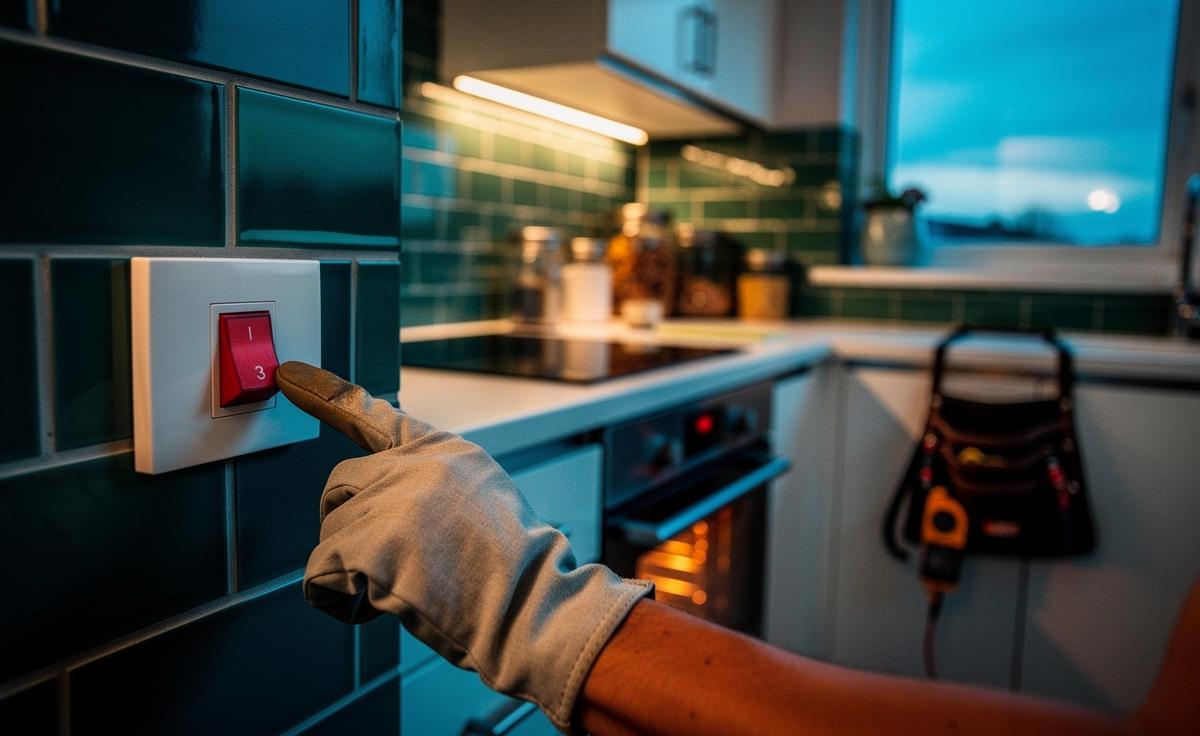
Electricians are unanimous on one rule: use the cooker isolator, not the consumer unit, for routine on/off. The isolator—often a chunky red switch on the splashback or nearby wall—cuts power to the oven circuit locally and safely. Do not repeatedly toggle the circuit breaker in your consumer unit; it’s not designed for day‑to‑day switching. Equally important, let cooling fans finish after roasting or cleaning. Some ovens require a run‑down to protect internal electronics.
- Locate the dedicated cooker isolator (usually a red rocker switch on a 45A plate).
- After cooking, wait until the oven’s cooling fan stops before switching off.
- For pyrolytic cleaning cycles, never cut power mid‑programme; allow the full cool‑down.
- Gas ovens with electric ignition: expect the clock to reset; set the time before the next use to restore safety interlocks.
- If your isolator is a fused spur, ensure the correct fuse rating (commonly 13A for smaller appliances; cookers often use a higher‑rated circuit with an isolator).
- Where the circuit is protected by an RCD or RCBO, occasional trips may indicate a fault—consult a competent person.
If in doubt about your setup—particularly in older properties—have a NICEIC or NAPIT‑registered electrician confirm the circuit, isolator rating, and safe operating practice. The goal is simple: remove standby consumption without compromising cooling, safety, or the appliance warranty.
Pros vs. Cons of Killing Standby Power
There’s no one‑size‑fits‑all answer. For many households, switching the oven off between uses is a tidy win; for others, it’s a marginal gain that introduces faff. The balance depends on your oven’s standby draw and how much you value features like scheduling or remote control. Knowing the trade‑offs lets you choose deliberately rather than by habit.
| Pros | Cons |
|---|---|
| Lower bills by eliminating 24/7 phantom load. | Resets the clock and timers—mildly inconvenient. |
| May extend life of control boards by reducing heat/idle time. | Smart features (Wi‑Fi updates, remote preheat) won’t work when powered down. |
| Supports a whole‑home energy‑saving habit. | Cutting power before cooling fans finish can stress components. |
| Simple, free, and reversible change. | Some models recall fault codes after power loss—rare, but possible. |
For a quick sense check, measure your oven’s draw with a plug‑in meter if it’s on a 13A plug, or ask a pro to test a hard‑wired unit. If standby exceeds ~5W, switching off between uses is usually worth it; below that, the savings shrink and convenience might win.
A Case Study from the Van: Small Tweaks, Real Savings
On a recent call‑out in Leeds, an electrician I shadowed audited a family kitchen where bills had crept up despite a new tariff. His clamp meter showed the built‑in oven sipping a steady 9W on standby. The fix? Coach the family to use the isolator after the fan stopped, and repeat the exercise across other appliances. We pencilled conservative savings and returned a month later: down about £5 on electricity, with identical cooking habits. No silver bullets—just disciplined trimming of background loads. Here’s the quick sketch he left on their fridge:
| Appliance | Standby (W) | Annual Cost (£, 28p/kWh) |
|---|---|---|
| Built‑in oven | 9 | ~22 |
| Microwave (clock) | 3 | ~7 |
| Dishwasher (panel) | 4 | ~10 |
| Total trimmed | — | ~£39 per year |
The numbers won’t be identical in every home, but the pattern holds. Target the biggest idle draws first, then standardise the habit. Ovens, with their ever‑bright clocks and modern touchscreens, are often low‑hanging fruit.
Why Switching Off Isn’t Always Better
There are sensible exceptions. Some premium ovens push firmware and safety updates via Wi‑Fi; killing power routinely can delay patches. Households reliant on timed start or Sabbath mode may also prefer standby continuity. And a minority of ovens use microcontrollers that behave oddly after loss of power, flashing errors until the time is reset—a nuisance rather than a hazard, but still a factor. If your oven uses a vigorous post‑cook fan, prioritise cool‑down over instant switch‑off. Finally, in rentals or HMOs, house rules may constrain who can access the isolator. A neat compromise is a weekly reset: leave the oven live during heavy cooking periods, switch it off overnight or when you’re away for days. The guiding principle is pragmatic, not purist—cut watts when it’s easy, avoid hassles when it’s not.
Cutting the oven’s standby draw won’t transform your finances, but in a kitchen packed with electronics it’s a steady, predictable win. Use the cooker isolator, respect cooling cycles, and treat smart features as a conscious trade‑off. Little choices—multiplied across appliances and weeks—become meaningful savings by year’s end. As energy prices zigzag and households hunt for certainty, will you build a simple “switch‑off” routine into your cooking rhythm, or is the convenience of an always‑ready oven worth a few extra pounds a year for your home?
Did you like it?4.5/5 (26)