In a nutshell
- 🧘 Tai Chi as a gentle daily practice outperforms long walks or sporadic gym sessions for over‑70s by enhancing balance, posture, and proprioception with low joint load—often in just 10 minutes a day.
- 🛡️ Strong evidence—including trials and reviews—shows reduced fall risk, better functional reach, and higher adherence with Tai Chi compared to walking alone, thanks to its focus on reactive balance.
- ⚙️ A simple routine: slow weight shifts, soft knees, relaxed arm sweeps, and smooth breathing; progress by narrowing stance or slowing tempo, using a counter for safety while building eccentric control.
- 🔁 Why “more” isn’t always better: walking is linear and machines isolate muscles, while Tai Chi trains multi‑directional control; treat it as a daily anchor that amplifies benefits of other activities.
- 👵 Real‑world win: a 79‑year‑old swapped a weekly gym circuit for brief daily Tai Chi and improved sit‑to‑stand, steadier turns, and confidence—showing how frequent, gentle practice sustains independence.
For adults over 70, the most powerful health habit may not be pounding pavements or pushing iron. It’s a gentle daily movement that trains balance, posture, and confidence: Tai Chi. Practised in short, regular bouts, Tai Chi’s slow, flowing shifts challenge the body’s internal GPS—proprioception—and the reflexes that prevent falls. Unlike long walks or sporadic gym sessions, it pairs coordination with breath, cultivates joint-friendly strength, and builds resilience where it matters most: everyday tasks. Small, precise practice performed often can beat bigger, harder sessions done rarely. Here’s how this deceptively simple movement outperforms the usual prescriptions—and how to start today with confidence.
Why Gentle Beats Gruelling After 70
Ageing subtly reshapes the priorities of training. The headline outcomes—longer life, stronger legs, steadier steps—depend less on single hard sessions and more on the nervous system’s capacity to coordinate body segments under low stress. Tai Chi delivers that stimulus by combining weight shifting, ankle strategy, soft knee flex, and upright posture with a calming breathing rhythm. The result: better balance and fewer stumbles, without the joint pounding that can follow brisk hill walks or heavy machines.
Large reviews of community programmes consistently report that Tai Chi reduces fall risk and improves functional reach more than walking alone, and often with higher adherence. That’s because the skill demand is engaging, the intensity is forgiving, and the practice transfers directly to daily life—getting out of a chair, turning to reach a cupboard, stepping off a kerb. In simple terms, it trains the “catch yourself” moment. For many over 70, that’s the difference between a scare and a fracture.
The Daily Movement: Tai Chi Flow You Can Feel in Ten Minutes
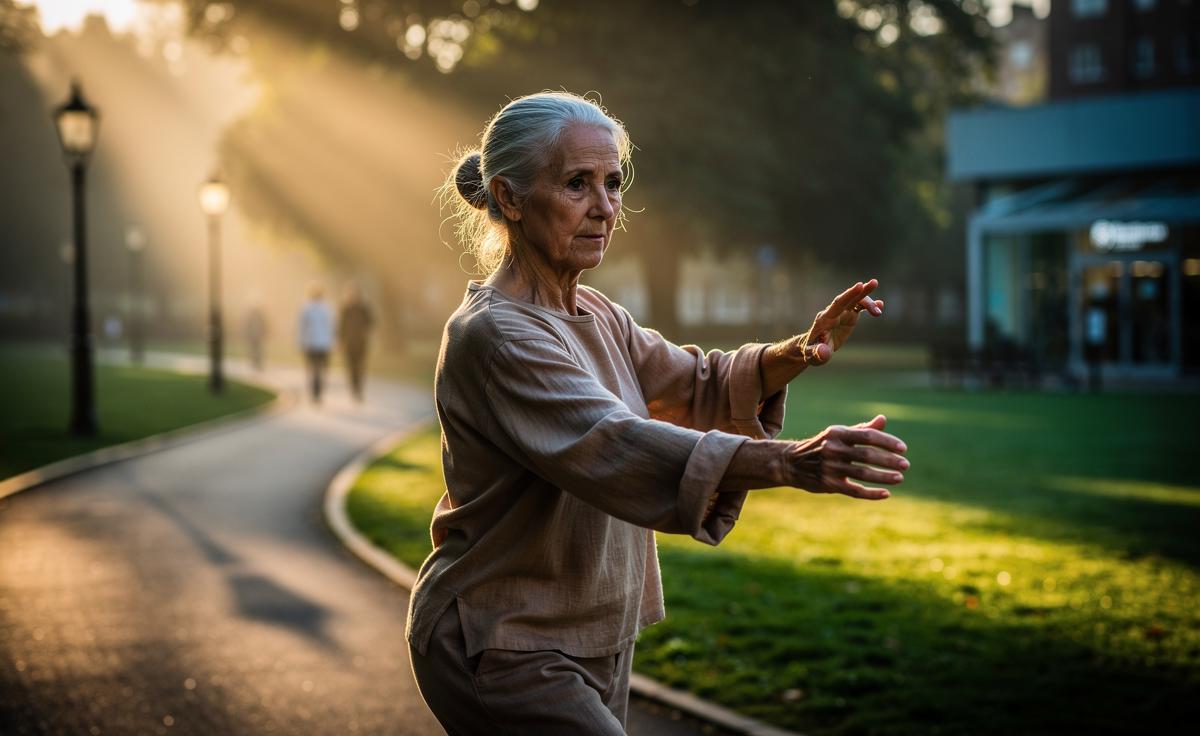
A compact routine—10 minutes, once or twice daily—centres on slow, continuous transitions. Stand tall, feet hip-width. Inhale as you shift weight to the right, let the left heel float, knees soft, crown lifted. Exhale, settle through the tripod of the right foot (big toe, little toe, heel). Now glide to the left. Add gentle arm sweeps at chest height, wrists relaxed, shoulders down. Keep the spine long, eyes forward, and the breath smooth. Aim for 60–80 quiet weight shifts, never rushing. If balance feels uncertain, use a kitchen counter as a “safety rail.”
What’s happening under the hood? You are rehearsing the ankle-to-hip “balance chain,” reinforcing joint position sense, and building eccentric control—the braking strength that prevents oversteps. Small loads, many high-quality repetitions, and attention to posture create high signal, low stress training for the vestibular system. Most newcomers report warmer feet, looser hips, and steadier turns within two weeks. Progress by narrowing your stance slightly, slowing transitions, or practising eyes-soft focus to enhance sensory integration.
Evidence and Real-World Stories From UK Clinics
In falls clinics and community centres across the UK, clinicians increasingly pair walking with Tai Chi because it targets the missing ingredient: reactive balance. Randomised trials and meta-analyses, including Cochrane reviews, indicate meaningful reductions in falls and improved lower-limb function, often outperforming aerobic-only plans for balance-centric outcomes. Importantly, Tai Chi invites daily consistency—short, low-friction sessions that slot between breakfast and the school run of grandparenting life.
Consider Margaret, 79, from Leeds. After a winter slip, she swapped one long weekly gym circuit for a 12-minute morning flow and a five-minute evening top-up. “The stairs feel calmer,” she told me. Her physiotherapist noticed quicker sit-to-stand times and smoother turns in the clinic’s corridor test. These are ordinary wins: fewer wobbles on buses, less fatigue after shopping, and the quiet confidence that keeps people social. Independence is a skill, and skills thrive on frequent practice. Tai Chi gives that practice without the recovery cost that can derail habit-building.
Why Long Walks and Gym Workouts Aren’t Always Better
Walking is excellent for heart health and mood, and resistance machines build muscle. But for falls prevention and day-to-day stability, they can miss the multi-directional, low-amplitude control that real life demands. Pavement walking is rhythmic and linear; most trips and missteps aren’t. And while leg presses are strong medicine for strength, they don’t train the micro-adjustments of ankles and hips needed during a sudden sideways nudge. Specificity matters: if you want steadier balance, you must practise balance—gently and often.
Here’s a clear comparison across typical priorities.
| Activity | Primary Benefit | Balance Challenge | Joint Load | Equipment | Adherence (Likely) |
|---|---|---|---|---|---|
| Tai Chi (10–15 min daily) | Reactive balance, posture, calm | High (multi-directional) | Low | None | High (short, home-friendly) |
| Long Walk (45–60 min) | Aerobic fitness, mood | Low–moderate (linear) | Moderate (repetitive) | Supportive shoes | Moderate (weather-dependent) |
| Gym Circuit (2–3x weekly) | Strength, bone loading | Variable (often low) | Moderate–high (depending on load) | Machines/weights | Variable (travel/time cost) |
None of this argues against walking or strength work—they’re valuable. It argues for the daily anchor: a gentle, precise movement that continually updates your balance software, so everything else works better.
If you’re over 70, think of Tai Chi as the keystone in an arch—supporting walks, gardening, and even light resistance training by stabilising the base. A short, mindful routine practised most days cultivates strength you can use, balance you can trust, and the calm that keeps you adventurous. The best movement is the one you’ll repeat tomorrow with interest, not dread. Will you try ten quiet minutes today—perhaps before the kettle boils—and notice how your next set of stairs, bus ride, or kitchen turn feels different?
Did you like it?4.4/5 (24)